
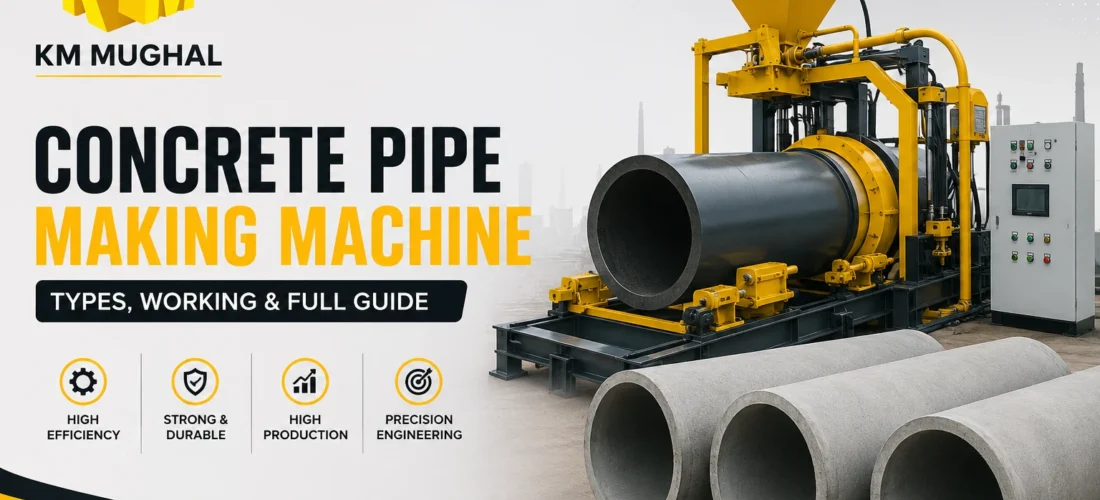
Reinforced concrete (RCC) pipes are the backbone of drainage, sewerage, and irrigation infrastructure, and the equipment that produces them determines both quality and profitability for a manufacturing business. A concrete pipe making machine molds, compacts, and cures concrete into strong, uniform pipes at scale, replacing slow manual casting with a repeatable industrial process. This guide breaks down the different machine types, how they work, and what to look for before investing in one.
What Is a Concrete Pipe Making Machine?
A concrete pipe making machine is industrial equipment that manufactures RCC pipes by molding, compacting, and shaping a cement-aggregate mix into strong, precision-sized pipes. Machines are available in semi-automatic and fully automatic configurations, with production capacity and pipe diameter varying by model. KM Mughal’s Horizontal RCC Cement and Concrete Pipes Making Machine is built for exactly this kind of high-volume, consistent pipe production.
Types of Concrete Pipe Making Machines
The right machine depends on production volume, budget, and the pipe strength your projects demand.
1. Semi-Automatic Pipe Making Machine
Involves some manual handling with moderate production speed. It’s a cost-effective entry point, best suited to small and medium businesses starting out in pipe manufacturing.
2. Fully Automatic Pipe Making Machine
Computerized and largely hands-off, this option delivers high output with minimal labor. It’s the standard choice for large industrial pipe manufacturing units.
3. Roller Suspension Pipe Machine
Uses a roller and vibration system to produce high-density RCC pipes with strong compaction, making it well-suited to high-strength infrastructure projects.
4. Vertical Vibration Pipe Machine
Runs on a vertical mold system with a fast production cycle and high dimensional uniformity, making it a strong fit for mass production setups.
How Concrete Pipe Making Machines Work
Regardless of type, the core production process follows the same stages:
- Concrete is prepared using cement, sand, and aggregates
- Material is fed into the pipe molds
- Vibration and pressure compact the mixture
- The pipe is formed and left to cure
- The finished RCC pipe is removed for drying
This process is what gives the pipe its strength and crack resistance.
Key Components of Concrete Pipe Making Machinery
A complete production setup typically includes:
- Pipe mold sets for different diameters
- Vibration system
- Hydraulic or mechanical press unit
- Concrete feeding system
- Control panel (on automatic machines)
- Curing and handling equipment
On the feeding side, pairing the machine with a reliable aggregate hopper or concrete mixer keeps the concrete supply consistent, which directly affects pipe quality.
Concrete Pipe Production Capacity
Output scales with machine type and automation level:
- Small machines: 20-50 pipes/day
- Medium machines: 50-150 pipes/day
- Large automatic plants: 150-500+ pipes/day
Choosing capacity based on realistic demand – rather than the largest available machine – keeps the investment efficient.
Applications of RCC Pipes
Pipes produced on these machines are used across:
- Drainage systems
- Sewerage networks
- Irrigation channels
- Road infrastructure projects
- Industrial water systems
Concrete Pipe Machine Price in Pakistan: What Affects the Cost
Pricing depends on several factors rather than a single flat rate:
- Automation level (semi-automatic vs. fully automatic)
- Production capacity per day
- Pipe diameter range the machine can handle
- Hydraulic and vibration system quality
- Custom plant requirements
It’s worth weighing production output and long-term durability alongside price, rather than choosing on upfront cost alone.
How to Choose the Right Concrete Pipe Machine
Before buying, work through:
- Required daily production
- Pipe sizes and diameter range needed
- Budget and future expansion plans
- Automation level needed
- Available site space and power supply
Common Mistakes to Avoid
- Choosing the wrong pipe diameter capacity
- Ignoring automation requirements for the scale of the business
- Buying low-quality molds
- Not planning production demand properly before investing
FAQs
What is a concrete pipe making machine used for?
It’s used to manufacture RCC pipes for drainage, sewerage, and construction projects.
How does a concrete pipe machine work?
It molds and compresses concrete using vibration and pressure systems, then cures the finished pipe.
What is the price of a concrete pipe making machine in Pakistan?
It depends on the machine type, production capacity, and automation level.
Which machine is best for a pipe manufacturing business?
Fully automatic machines suit large-scale production; semi-automatic machines suit smaller operations starting out.
Can one machine make different pipe sizes?
Yes, using interchangeable molds for different diameters.
How many pipes can be produced per day?
Anywhere from 20 to 500+ pipes per day depending on the machine type and capacity.
Get the Right Concrete Pipe Making Machine for Your Business
Whether you’re starting with a semi-automatic setup or scaling into a fully automatic production line, matching the machine to your capacity and pipe-size needs is what protects your investment. Explore KM Mughal’s RCC Pipe Making Machine or get in touch with our team for guidance on the right setup for your production goals.
Related Posts

Post a Comment